CKS Examcollection Free Dumps | Valid CKS Exam Tips
Wiki Article
DOWNLOAD the newest ValidVCE CKS copyright from Cloud Storage for free: https://drive.google.com/open?id=1gAc8cmrEdusMDXOl-z2YQ6gQo7FpspfJ
Choosing our CKS real dumps as your study guide means you choose a smart and fast way to get succeed in the certification exam. There are accurate CKS test answers and some explanations along with the exam questions that will boost your confidence to solve the difficulty of CKS Practice Test. You will enjoy great benefits if you buy our CKS copyright now and free update your study materials one-year.
Linux Foundation CKS (Certified Kubernetes Security Specialist) Exam is a certification program that is designed to assess and validate an individual's expertise in securing container-based applications and Kubernetes platforms. CKS exam is aimed at professionals who are responsible for securing Kubernetes clusters and ensuring that they are in compliance with industry-recognized security standards. The CKS Certification program is a vendor-neutral program that is open to all IT professionals who have a good understanding of Kubernetes and its security principles.
>> CKS Examcollection Free Dumps <<
Valid CKS Exam Tips & CKS Latest Test Prep
That's why ValidVCE offers actual Certified Kubernetes Security Specialist (CKS) (CKS) exam questions to help candidates copyright and save their resources. The Linux Foundation CKS Exam Questions provided by ValidVCE is of the highest quality, and it enables participants to copyright on their first try.
The CKS exam is a valuable certification program for professionals who are responsible for securing Kubernetes environments. It provides a comprehensive evaluation of an individual's knowledge and skills in Kubernetes security and validates their expertise in this area. With the growing adoption of Kubernetes, the CKS Certification can help professionals stand out in the job market and advance their careers in this field.
Linux Foundation Certified Kubernetes Security Specialist (CKS) Sample Questions (Q22-Q27):
NEW QUESTION # 22
SIMULATION
Create a network policy named restrict-np to restrict to pod nginx-test running in namespace testing.
Only allow the following Pods to connect to Pod nginx-test:-
1. pods in the namespace default
2. pods with label version:v1 in any namespace.
Make sure to apply the network policy.
- A. Send us your Feedback on this.
Answer: A
NEW QUESTION # 23
Your Kubernetes cluster hosts a sensitive application that uses secrets for storing critical data. You need to implement a robust security measure to ensure that these secrets are protected from unauthorized access.
Answer:
Explanation:
Solution (Step by Step):
1. Use Kubemetes Secret Manager Leverage Kubernetes' built-in secret management capabilities to store and manage sensitive data.
- Create a Secret: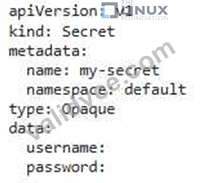
2. Restrict Access to Secrets: use R8AC (Role-Based Access Control) to limit access to secrets to authorized users or applications. Create custom roles or cluster roles that allow specific access to secrets based on your security needs. - Create a YAML file for the Custom Role: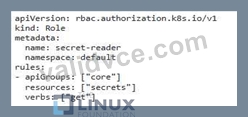
- Create a RoleBinding: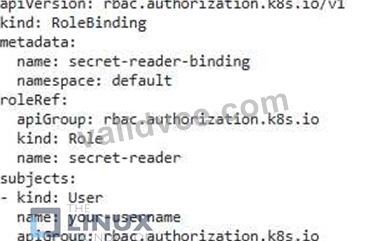
3. Mount Secret to Pods: Mount the secret to the pods that require access to the sensitive data. You can use volume mounts in your pod definitions. - Example Pod YAML: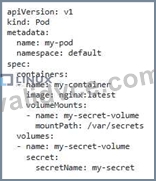
4. Limit Access within Pods: use environment variables or other security mechanisms within your pods to limit access to the secrets to only the necessary code components.
NEW QUESTION # 24
You are managing a Kubernetes cluster that uses a private Docker registry for storing container images. You need to secure the registry by restricting access to authorized users and teams. Design a solution using role-based access control (RBAC) to enforce the following policies:
- Developers in the "dev" team should be allowed to push and pull images to the registry.
- Operations team members should only be allowed to pull images.
- Security team members should have read-only access to the registry's metadata
Answer:
Explanation:
Solution (Step by Step) :
1. Create a Service Account for each team:
- Dev Team: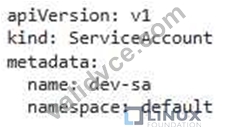
- Operations Team: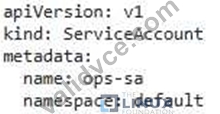
- Security Team: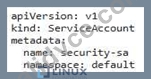
- Apply these ServiceAccount YAML files to the cluster using 'kubectl apply -f sa.yaml'. 2. Create a Role for each team: - Dev Team Role: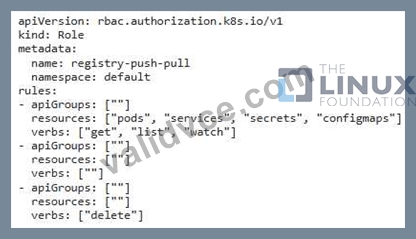
- Operations Team Role: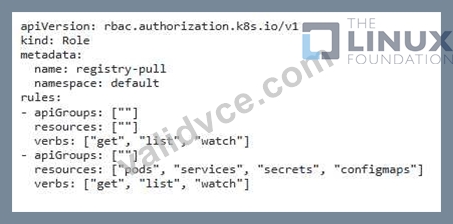
- Security Team Role: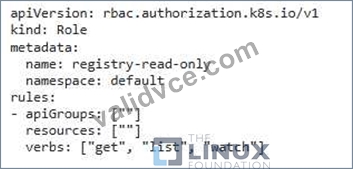
- Apply these Role YAML files to the cluster using 'kubectl apply -f roles-yaml'. 3. Bind the Roles to Service Accounts: - Dev Team: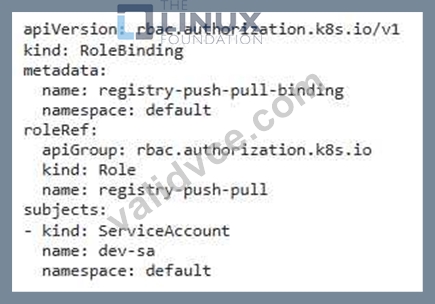
- Operations Team: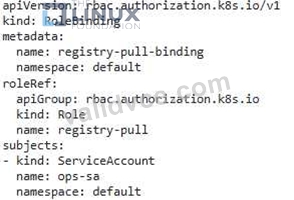
- security Team: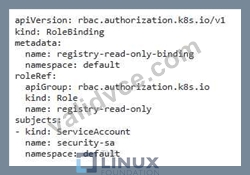
- Apply these RoleBinding YAML files to the cluster using 'kubectl apply -f rolebindings.yamr 4. Configure the Registry: - Ensure that your private Docker registry is configured to authenticate users and teams based on the specified RBAC rules. This may involve using a registry-specific Plugin or configuration file. 5. Test the Setup: - Use the created Service Accounts to access the registry. - Verify that each team nas the expected permissions and limitations. - For example, try pushing an image using the 'dev-sa' account and verify it is successful. Then, attempt to push an image using the Sops-sa- account and verify it is unsuccessful due to the missing permission.
NEW QUESTION # 25
SIMULATION
Context
You must fully integrate a container image scanner into the kubeadm provisioned cluster.
Task
Given an incomplete configuration located at /etc/kubernetes/bouncer and a functional container image scanner with an HTTPS endpoint at https://smooth-yak.local/review, perform the following tasks to implement a validating admission controller.
First, re-configure the API server to enable all admission plugin(s) to support the provided AdmissionConfiguration.
Next, re-configure the ImagePolicyWebhook configuration to deny images on backend failure.
Next, complete the backend configuration to point to the container image scanner's endpoint at https://smooth-yak.local/review.
Finally, to test the configuration, deploy the test resource defined in /home/candidate/vulnerable.yaml which is using an image that should be denied.
You may delete and re-create the resource as often as needed.
The container image scanner's log file is located at /var/log/nginx/access_log.
Answer:
Explanation:
See the Explanation below for complete solution
Explanation:
Below is the CKS exam style "do-this-exactly" runbook for Q3. It includes the minimal discovery commands (so you don't guess filenames), then the exact lines/blocks to set.
QUESTION 3 - ImagePolicyWebhook (Validating Admission) - Exam Steps
0) SSH + root
ssh cks000002
sudo -i
1) Identify the provided config files (no guessing)
ls -la /etc/kubernetes/bouncer
You are looking for files typically named like:
admission_configuration.yaml (AdmissionConfiguration)
imagepolicywebhook.yaml (ImagePolicyWebhookConfiguration) OR the ImagePolicyWebhook config embedded inside the AdmissionConfiguration kubeconfig (webhook kubeconfig) If unsure which is which, quick peek:
grep -R "ImagePolicyWebhook" -n /etc/kubernetes/bouncer
grep -R "AdmissionConfiguration" -n /etc/kubernetes/bouncer
grep -R "kubeconfig" -n /etc/kubernetes/bouncer
PART A - Reconfigure API Server to enable required admission plugin(s)
2) Edit API server static pod manifest
vi /etc/kubernetes/manifests/kube-apiserver.yaml
2.1 Enable the admission plugin ImagePolicyWebhook
Find the line starting with:
- --enable-admission-plugins=
Ensure ImagePolicyWebhook is included in that comma list.
Example (your list may differ; just add ImagePolicyWebhook):
- --enable-admission-plugins=NodeRestriction,ImagePolicyWebhook
If the flag does not exist, add one line under command::
- --enable-admission-plugins=ImagePolicyWebhook
2.2 Point API server to the provided AdmissionConfiguration
In the same file, ensure this flag exists (use the file in /etc/kubernetes/bouncer that contains AdmissionConfiguration):
- --admission-control-config-file=/etc/kubernetes/bouncer/admission_configuration.yaml If your file is named differently, use the real filename you found in step 1, but keep the flag name exactly --admission-control-config-file.
Save/exit:
:wq
Static pod will restart automatically (kubelet watches the manifest).
Optional quick watch:
docker ps | grep kube-apiserver
# or:
crictl ps | grep kube-apiserver
PART B - Configure ImagePolicyWebhook to deny images on backend failure
3) Edit the ImagePolicyWebhook config
One of these is true on your cluster:
Option 1 (most common in these tasks): ImagePolicyWebhook config is a standalone file Edit the file in /etc/kubernetes/bouncer that contains kind: ImagePolicyWebhookConfiguration:
grep -R "kind: ImagePolicyWebhookConfiguration" -n /etc/kubernetes/bouncer vi /etc/kubernetes/bouncer/<THE_FILE_YOU_FOUND>.yaml Set (or ensure) exactly:
defaultAllow: false
Option 2: ImagePolicyWebhook config is embedded inside AdmissionConfiguration Edit the AdmissionConfiguration file:
vi /etc/kubernetes/bouncer/admission_configuration.yaml
Find the plugin section for ImagePolicyWebhook and ensure the config includes:
defaultAllow: false
✅ Save/exit:
:wq
PART C - Point backend configuration to https://smooth-yak.local/review
4) Edit the webhook kubeconfig to use the scanner endpoint
Find the kubeconfig file referenced by the ImagePolicyWebhook config.
Search for kubeConfigFile:
grep -R "kubeConfigFile" -n /etc/kubernetes/bouncer
Open that kubeconfig path (example name below; yours may differ):
vi /etc/kubernetes/bouncer/kubeconfig
In kubeconfig, set the cluster server exactly:
clusters:
- cluster:
server: https://smooth-yak.local/review
✅ Save/exit:
:wq
PART D - Restart effect (make sure API server picks up config)
Because you already edited /etc/kubernetes/manifests/kube-apiserver.yaml, the API server restarted.
To be safe (and fast), force a restart by "touching" the manifest (no content change needed):
touch /etc/kubernetes/manifests/kube-apiserver.yaml
PART E - Test: apply vulnerable workload and confirm it is denied
5) Use admin kubeconfig (because old kubectl config may break)
export KUBECONFIG=/etc/kubernetes/admin.conf
kubectl get nodes
6) Deploy the test resource (should be DENIED)
kubectl apply -f /home/candidate/vulnerable.yaml
Expected: admission error/denied message.
If it already exists:
kubectl delete -f /home/candidate/vulnerable.yaml
kubectl apply -f /home/candidate/vulnerable.yaml
PART F - Verify the scanner was called (log check)
7) Check scanner access log
tail -n 50 /var/log/nginx/access_log
You should see requests hitting /review.
Quick "what to check if it doesn't deny"
Run these in order:
Confirm API server flags:
grep -n "enable-admission-plugins" /etc/kubernetes/manifests/kube-apiserver.yaml grep -n "admission-control-config-file" /etc/kubernetes/manifests/kube-apiserver.yaml Confirm deny-on-failure:
grep -R "defaultAllow" -n /etc/kubernetes/bouncer
Must show:
defaultAllow: false
Confirm endpoint:
grep -R "server: https://smooth-yak.local/review" -n /etc/kubernetes/bouncer API server logs (docker runtime):
docker ps | grep kube-apiserver
docker logs $(docker ps -q --filter name=kube-apiserver) --tail 80
If you paste the output of:
ls -/etc/kubernetes/bouncer
grep -R "kind: AdmissionConfiguration" -n /etc/kubernetes/bouncer
grep -R "ImagePolicyWebhook" -n /etc/kubernetes/bouncer
NEW QUESTION # 26
Analyze and edit the given Dockerfile
FROM ubuntu:latest
RUN apt-get update -y
RUN apt-install nginx -y
COPY entrypoint.sh /
ENTRYPOINT ["/entrypoint.sh"]
USER ROOT
Fixing two instructions present in the file being prominent security best practice issues Analyze and edit the deployment manifest file apiVersion: v1 kind: Pod metadata:
name: security-context-demo-2
spec:
securityContext:
runAsUser: 1000
containers:
- name: sec-ctx-demo-2
image: gcr.io/google-samples/node-hello:1.0
securityContext:
runAsUser: 0
privileged: True
allowPrivilegeEscalation: false
Fixing two fields present in the file being prominent security best practice issues Don't add or remove configuration settings; only modify the existing configuration settings Whenever you need an unprivileged user for any of the tasks, use user test-user with the user id 5487
Answer:
Explanation:
FROM debian:latest
MAINTAINER [email protected]
# 1 - RUN
RUN apt-get update && DEBIAN_FRONTEND=noninteractive apt-get install -yq apt-utils RUN DEBIAN_FRONTEND=noninteractive apt-get install -yq htop RUN apt-get clean
# 2 - CMD
#CMD ["htop"]
#CMD ["ls", "-l"]
# 3 - WORKDIR and ENV
WORKDIR /root
ENV DZ version1
$ docker image build -t bogodevops/demo .
Sending build context to Docker daemon 3.072kB
Step 1/7 : FROM debian:latest
---> be2868bebaba
Step 2/7 : MAINTAINER [email protected]
---> Using cache
---> e2eef476b3fd
Step 3/7 : RUN apt-get update && DEBIAN_FRONTEND=noninteractive apt-get install -yq apt-utils
---> Using cache
---> 32fd044c1356
Step 4/7 : RUN DEBIAN_FRONTEND=noninteractive apt-get install -yq htop
---> Using cache
---> 0a5b514a209e
Step 5/7 : RUN apt-get clean
---> Using cache
---> 5d1578a47c17
Step 6/7 : WORKDIR /root
---> Using cache
---> 6b1c70e87675
Step 7/7 : ENV DZ version1
---> Using cache
---> cd195168c5c7
Successfully built cd195168c5c7
Successfully tagged bogodevops/demo:latest
NEW QUESTION # 27
......
Valid CKS Exam Tips: https://www.validvce.com/CKS-exam-collection.html
- New CKS Test Blueprint ???? Flexible CKS Testing Engine ???? Dumps CKS Free ???? ✔ www.examcollectionpass.com ️✔️ is best website to obtain 《 CKS 》 for free download ????New CKS Test Blueprint
- CKS Valid Exam Sample ???? CKS Reliable Exam Registration ➖ Practice CKS Mock ???? Search for ➥ CKS ???? and easily obtain a free download on 【 www.pdfvce.com 】 ????CKS Exam Dumps Collection
- New copyright CKS Book ???? Dumps CKS Free ???? New copyright CKS Book ???? Easily obtain free download of “ CKS ” by searching on ⮆ www.testkingpass.com ⮄ ????CKS Valid Test Preparation
- 2026 CKS Examcollection Free Dumps 100% Pass | High-quality Valid CKS Exam Tips: Certified Kubernetes Security Specialist (CKS) ⛑ Search for ➥ CKS ???? and easily obtain a free download on [ www.pdfvce.com ] ????CKS Mock Test
- Trustable CKS Examcollection Free Dumps - Leading Provider in Qualification Exams - Correct Valid CKS Exam Tips ???? Search on ▛ www.examdiscuss.com ▟ for ▛ CKS ▟ to obtain exam materials for free download ????CKS Test Question
- New CKS Test Blueprint ???? CKS Valid Test Preparation ???? Practice CKS Mock ???? Open ( www.pdfvce.com ) enter ☀ CKS ️☀️ and obtain a free download ????CKS Valid Test Preparation
- CKS Exam Objectives ???? CKS Mock Test ???? Flexible CKS Testing Engine ???? The page for free download of ( CKS ) on 「 www.verifieddumps.com 」 will open immediately ????New CKS Test Blueprint
- 100% Free CKS – 100% Free Examcollection Free Dumps | Excellent Valid Certified Kubernetes Security Specialist (CKS) Exam Tips ???? Easily obtain free download of 《 CKS 》 by searching on ▷ www.pdfvce.com ◁ ????Practice CKS Mock
- 100% Free CKS – 100% Free Examcollection Free Dumps | Excellent Valid Certified Kubernetes Security Specialist (CKS) Exam Tips ⛅ Open website ▷ www.prepawaypdf.com ◁ and search for ( CKS ) for free download ????CKS Exam Dumps Collection
- Perfect CKS Examcollection Free Dumps - Leading Offer in Qualification Exams - Useful Valid CKS Exam Tips ???? Go to website ➥ www.pdfvce.com ???? open and search for ➥ CKS ???? to download for free ????Latest CKS Exam Notes
- 2026 Trustable CKS – 100% Free Examcollection Free Dumps | Valid CKS Exam Tips ???? Immediately open ( www.prepawayexam.com ) and search for ✔ CKS ️✔️ to obtain a free download ????CKS Exam Objectives
- nikolasxnao267374.plpwiki.com, thesocialvibes.com, socialstrategie.com, deacontpbf197168.loginblogin.com, lucfast450573.iyublog.com, abelbsro436207.oneworldwiki.com, emilieffvt579151.wikiannouncement.com, leauyfr451780.azuria-wiki.com, kaitlynykgy113993.wikinewspaper.com, maejfjr916471.digitollblog.com, Disposable vapes
BONUS!!! Download part of ValidVCE CKS dumps for free: https://drive.google.com/open?id=1gAc8cmrEdusMDXOl-z2YQ6gQo7FpspfJ
Report this wiki page